
New Zealand has joined a project to accelerate artificial intelligence warfighting capabilities that the United States calls "pivotal" and the "foundation" to winning battles.
Project Arcadia aims to build a shared battlefield command system that gets the US and its core Five Eyes intelligence partners up to the sort of attack speeds seen in the Iran war.
Defence Minister Chris Penk's office said cabinet's approval for funding Arcadia would be sought as part of digital modernisation work.
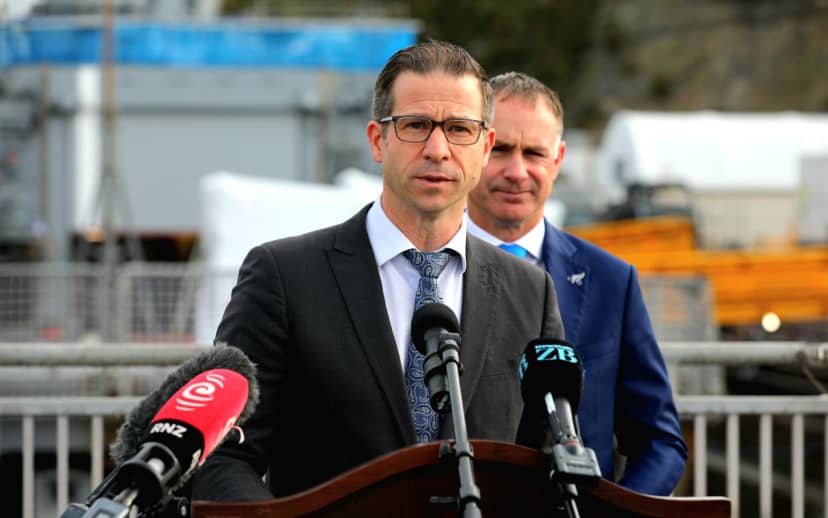
"This will upgrade existing NZ Defence Force systems used to communicate with Five Eyes partners, and allows information between the partners to be shared more easily and securely," his spokesperson said.
The Pentagon called Arcadia "the operational imperative for our time" that aligned with the priorities of War Secretary Pete Hegseth.
"It is the digital backbone of our coalition, the very ecosystem that will empower our warfighters with [the] data supremacy and decision dominance they need to win on the battlefields of today and of tomorrow."
The NZDF said it would play a full role in Arcadia, "but for national security reasons, we are unable to elaborate on how or which tools will be used".
'Deliver overwhelming strength'
The Iran war has demonstrated how AI could speed up targeting by up to 50 times.
The Pentagon has quickly committed to spending billions on AI, but another top priority - linking it all up with its closest partners - has been difficult.
Arcadia would deliver that, said a spokesperson.
"It is the foundation that will allow us to deliver overwhelming strength and decisive advantage."
Penk's office said it was in the information-gathering stage.
"NZDF is not yet using Arcadia."
The Five Eyes partners say they are engaged in a "sprint" to build Arcadia. US defence media reported each Five Eyes nation had to report back in November on work they'd done.
Aligns with Hegseth - Pentagon
Arcadia was announced as NZ, US, Australia, the UK and Canadian defence leaders emerged from a Combined Digital Leadership Summit last month. Six NZDF personnel were there.
The Pentagon heralded it as "forging the digital battlespace" and lining up with Hegseth's push for "peace through technical strength", echoing a favourite slogan of Hegseth's boss, US President Donald Trump, "Peace through strength".
Asked if he had sought any advice or assurance from Defence about sovereignty, Penk's office said: "As with previous Five Eyes arrangements, each nation's sovereign requirements are maintained."

Five Eyes representatives committed to Project Arcadia - from left, Ross Ermel (Canada), Brigadier Esther Harrop (New Zealand), Kirsten Davies (USA), Charles Forte (United Kingdom) and Chris Crozier (Australia).
LinkedIn/Department of War
The NZDF said the aim was better info sharing, while protecting sovereign data obligations and interests.
"It has been established so that partner nations can more securely protect their data, and have more assurance over who they share it with and what they share."
'System of systems'
Earlier, the Otago Daily Times reported two local commentators who were skeptical, calling Arcadia "delusional" and lacking substance.
However, the Pentagon has a big budget for building a "system of systems" and been working on it seriously since about 2022.
It has already spent about $350m on joint command-and-control projects that cover research into 'Globally Integrated Operations', where labs replicate partner nations' combined systems. It calls this its 'C5' programme.
It planned to up the annual spend related to this by more than five times in fiscal 2027, with a big chunk of that to expand access to the AI-driven Maven smart system used in Iran.
Maven has been crucial for matching the tech to the ambitions. Maven runs data integration and operational-planning systems, as well as automatic target detection and analysis.
READ MORE
- NZ and US sign 'statement of intent' over military space operations
- Distance can no longer be NZ’s defence strategy. Could Japan be part of the answer?
- STARLIFT draws in NZ as states seek rocket launchpads
- RNZAF P-8A Poseidon successfully launches Harpoon missiles
Japan's is the latest military integrating Maven, leading newspaper Asahi Shimbun has reported. This would require revising three key rules to allow AI into its command-and-control chain. Australia, New Zealand's only ally, has been testing Maven, too.
The NZDF has said it is not contemplating following suit.
Arcadia does not spring up fully formed, but builds on existing tech, such as the INDOPACOM Mission Network (IMN) used in the huge exercise Balikatan in the Philippines that the NZDF took part in earlier this year.
Last year, IMN replaced 20 separate networks and, by the end of this year, was expected to connect 23 countries. US commanders have talked about having to swap thumb drives or CDs, or even have "people looking at two different monitors" on multinational exercises, before IMN came along.
Exchange layer
A key with Arcadia was a technical decision to build a data exchange layer on top of existing Five Eyes national systems, according to US defence media.
"This design principle was specifically requested by several nations, whose domestic acquisition rules and operational security constraints limit the pace at which national platform software can be updated or replaced."
It appeared aimed to overcome the problem of data systems that vary hugely in size and speed.
Penk's office said Arcadia was part of investment in digital modernisation in 2025-28 outlined in the Defence Capability Plan last year. The plan did not mention projects by name.
The NZDF said the partners committed to share designs to save money.
In the run-up last November at another Five Eyes digital summit, the US and Canada signed a deal for secure communications across their defence networks - a Public Key Infrastructure (PKI) Cross-Certification Arrangement (CCA).
The summit discussed "data sharing across nations" and associated tech, such as a Digital Targeting Web, said Canada's defence department.
A [https://assets.publishing.service.gov.uk/media/69bc12cd8006048065f73d17/Digital_Targeting_Web_Challenge_Book_2026.pdf
Digital Targeting Web being built in the UK] "improves the speed and efficiency of targeting, Command and Control (C2), intelligence, surveillance and situational awareness", said the British defence department.
'Dazzle, deceive, destroy'
Command-and-control (C2) systems integrate sensors - such as satellites and drones that take images of what to shoot or defend - with weapons and decision-making mechanisms. This all relies on sharing data quickly.
Arcadia would lay the foundation to turn "vast amounts of allied data" into a unified, real-time common operating picture, said the Pentagon.
The flipside of being able to "see, understand, decide and act through every single domain", as the top US commander in the Indo-Pacific Samuel Paparo recently put it, is to try to block the enemy from doing the same.
On that score, Hegseth has repeatedly stressed the need to counter China's "kill web" of sensors-and-shooters over the Pacific.
Paparo said: "Our first priority is the ability to counter an adversary's ability to see, understand, decide and act through every single domain, to be able to dazzle, to be able to deceive, to be able to destroy those components that allow an adversary to exercise decision superiority."
The next Arcadia meeting is in November in Sydney.


